
Finding out your home has high radon levels can lead to one big question: what happens next?
The good news is that high radon levels can often be reduced with a properly designed radon mitigation system. One of the most common and effective methods used in Canadian homes is called Active Soil Depressurization, often shortened to ASD.
For many Manitoba homeowners, ASD is the main method used to reduce radon because it targets the source pathway beneath the home. Instead of trying to deal with radon after it has already entered the living space, the system helps draw radon-containing soil gas away before it can build up indoors.
What Is Radon Mitigation?
Radon mitigation means reducing radon levels inside a home.
Radon is a naturally occurring radioactive gas that comes from the breakdown of uranium in soil and rock. It can enter homes through cracks, gaps, sump pits, floor drains, construction joints, and other openings in the foundation. Because radon has no colour, smell, or taste, the only way to know the level in a home is to test.
Health Canada’s Canadian radon guideline is 200 Bq/m³. If a home’s long-term average radon level is above that guideline, Health Canada recommends taking steps to reduce it.
Radon mitigation is not usually about “cleaning” radon from the indoor air after it enters. In most cases, the goal is to control the pressure and pathway beneath the home so radon is redirected outdoors before it enters the living space.
Different homes may require different mitigation approaches. A home’s foundation type, basement layout, slab condition, sump pit, crawl space, soil conditions, and pipe routing options can all affect the final system design.
What Is Active Soil Depressurization?
Active Soil Depressurization is a fan-powered radon mitigation method that creates suction beneath the foundation of a home.
The system uses a suction point, PVC piping, and a radon fan to draw radon-containing soil gas from beneath the slab or foundation area. That gas is then vented outdoors, usually above the roofline or through another safe exterior discharge location depending on the home and applicable requirements.
The name sounds technical, but it is easier to understand when broken down:
- Active means the system uses a fan.
- Soil refers to the soil, gravel, or sub-slab area beneath the home.
- Depressurization means the system creates lower pressure beneath the foundation so soil gas moves into the pipe instead of into the house.
A simple way to think about it is this: instead of letting soil gas find random paths through cracks and openings, ASD gives it a controlled path out of the home.
Health Canada’s Radon Reduction Guide for Canadians identifies active soil depressurization as a commonly recommended approach when larger radon reductions are needed.
How Does an ASD System Work?
A radon mitigation system is designed around the specific home. While the exact installation can vary, the general process usually looks like this:
- A mitigation professional assesses the home
The contractor reviews the test results, foundation type, basement layout, sump pit, crawl spaces, mechanical room, and possible pipe routes. - A suction point is selected
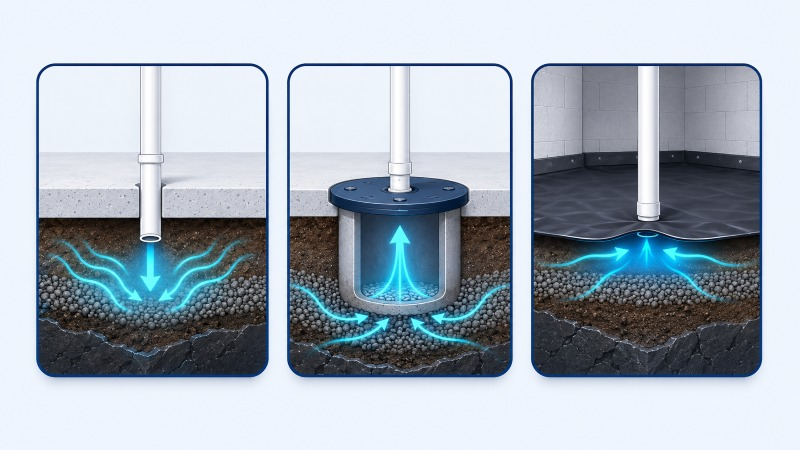
Depending on the home, the suction point may be installed through the basement slab, connected through a properly sealed sump system, or placed beneath a crawl space membrane. - PVC piping is installed
The pipe connects the suction point to a radon fan and exterior discharge route. - A radon fan creates suction
The fan runs continuously to maintain lower pressure beneath the foundation. - Soil gas is drawn into the system
Radon-containing gas moves into the pipe rather than through openings in the home. - The gas is vented outdoors
The system exhausts the gas outside, away from living spaces. - The system is checked and tested
After installation, follow-up radon testing is used to confirm that levels have been reduced.
The system should be sealed so it is not intentionally pulling conditioned air from inside the living space. The goal is to pull from below the home, not from the home itself.
Common Types of Active Soil Depressurization
ASD is an umbrella term. The right version depends on how the home is built.
Sub-Slab Depressurization
Sub-slab depressurization is commonly used in homes with a concrete basement floor. A suction point is created through the slab so the system can draw soil gas from the gravel or soil beneath the basement floor.
This is one of the most common forms of radon mitigation in homes with basements.
Sump Pit Depressurization
Some homes may use sump pit depressurization as part of the radon mitigation strategy. This can work when the sump pit has good communication with the area beneath the slab.
The sump pit must be properly sealed, and the system should be assessed by a qualified radon mitigation professional. Not every sump pit is suitable as the primary suction point.
Sub-Membrane Depressurization
Sub-membrane depressurization is often used in crawl spaces or areas with exposed soil or gravel.
A durable membrane is installed over the exposed ground and carefully sealed. Suction is then applied beneath the membrane to draw radon-containing soil gas away before it can enter the home.
Why ASD Is Effective
ASD works well in many homes because it targets the area where radon usually enters: the soil beneath and around the foundation.
Radon is driven into homes by pressure differences. In cold climates like Manitoba, indoor-outdoor temperature differences, heating systems, exhaust fans, and stack effect can all influence how soil gas moves. By creating suction beneath the foundation, an ASD system helps redirect that soil gas into a controlled pipe system.
A properly designed ASD system can significantly reduce radon levels, but results depend on the home. Fan selection, suction point placement, sealing, soil communication, discharge routing, and post-mitigation testing all matter.
C-NRPP’s steps to reduce radon recommend working with trained radon professionals when mitigation is needed.
What Homeowners Should Expect From a Radon Mitigation Project
For Manitoba homeowners considering radon mitigation in Winnipeg or surrounding areas, the process should start with a proper review of the home and test results.
A radon mitigation project may include:
- Reviewing the radon test results
- Inspecting the basement, slab, sump pit, crawl spaces, and mechanical areas
- Identifying the best suction point or points
- Planning the pipe route and fan location
- Installing the suction point, piping, fan, sealing, and discharge route
- Checking system operation
- Completing follow-up radon testing
A good mitigation plan should be specific to the home. Two houses on the same street may require different approaches depending on how they were built and how soil gas moves beneath them.
Do You Need Mitigation Before Testing?
In most cases, testing comes first.
You cannot know whether a home needs mitigation by looking at it. Radon levels can vary from home to home, even in the same neighbourhood. The Canadian Cancer Society notes that testing is the only way to know radon levels in a home.
Short-term radon testing can be useful as a screening tool, especially when homeowners want an initial indication of their levels. Long-term testing gives a better picture of average exposure over time.
If you already have a valid radon test showing high levels, the next step is to request a mitigation estimate. If you have not tested yet, start with radon testing so you know what level you are dealing with.
Why This Matters for Manitoba and Winnipeg Homeowners
Radon is a concern in many parts of Manitoba. The Province of Manitoba’s radon information page notes that radon levels can change from season to season and even day to day.
Many Manitoba homes have basements, slabs, sump pits, and cold-weather pressure conditions that can affect how soil gas enters the home. That does not mean every Manitoba home has high radon. It means homeowners should test rather than guess.
For Winnipeg homeowners, radon testing is the practical first step. If the results are high, a properly designed radon mitigation system can help reduce levels and protect the home long term.
Ready to Take the Next Step?
Whether you are still trying to understand your radon levels or already know your home needs mitigation, RadonPatrol Inc. can help you choose the right next step.
If you have not tested yet, book a radon test with RadonPatrol.
If you already have high radon results, request a radon mitigation estimate and we can assess the best approach for your home.
FAQs About Active Soil Depressurization
What is Active Soil Depressurization?
Active Soil Depressurization is a radon mitigation method that uses a fan and pipe system to draw radon-containing soil gas from beneath a home and vent it outdoors.
Is ASD the same as radon mitigation?
ASD is one type of radon mitigation. It is one of the most common methods used to reduce radon in homes, but the exact approach depends on the foundation and home layout.
Does every home need the same type of radon mitigation system?
No. Some homes may use sub-slab depressurization, while others may need sump pit depressurization, sub-membrane depressurization, or a combination of approaches.
Can a sump pit be used for radon mitigation?
Sometimes. A sump pit may be used if it connects well with the area beneath the slab and can be properly sealed. A qualified radon mitigation professional should assess whether it is suitable.
Should I test before getting a radon mitigation estimate?
Yes, unless you already have valid radon test results. Testing confirms whether mitigation is needed and helps guide the next step.
Not Sure Where to Start?
Start with a radon test. From there, we will guide you through the right next step for your home.

